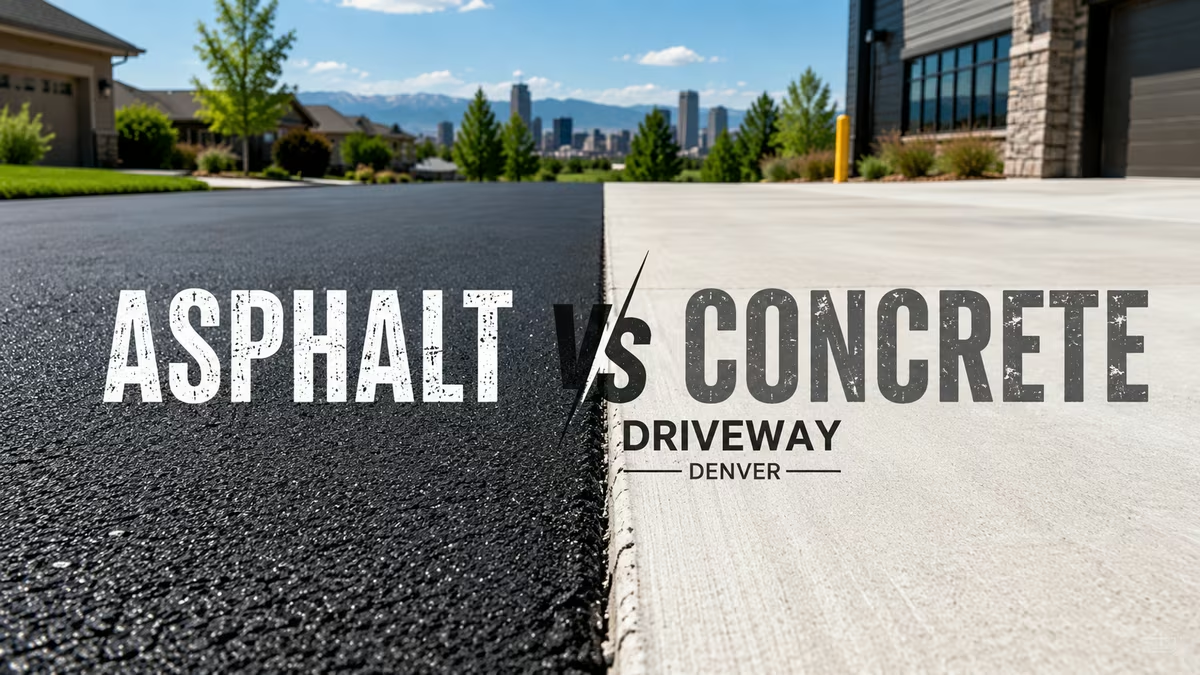
Asphalt vs. Concrete Driveways in Denver: Which Is Right for You?
Nearly every comparison you will read is written for the national average. Denver is not the national average — the soil moves here, and that changes the answer. We install both, so here is the honest version.
The short answer
- For a driveway in the Denver metro, asphalt is usually the better choice. Lower upfront cost, faster to install, and critically — it flexes when the clay soil beneath it moves.
- For a patio, walkway or decorative flatwork, concrete usually wins. Design options, a harder wearing surface, and no ongoing sealing cycle.
- The deciding local factor is expansive clay soil. Much of the Front Range sits on ground that swells when wet and shrinks when dry. Asphalt tolerates that movement. Concrete cracks under it.
- Concrete is not wrong for a driveway — it just needs to be specified properly: air-entrained, 4,000 PSI, on a prepared sub-base, with correct control joints.
- Whichever you choose, the base preparation underneath decides how long it lasts. It is the invisible part of the job and the first thing a low bid removes.
Why Denver changes the answer
If you read a national comparison of asphalt and concrete driveways, you will get a reasonable summary of a genuinely close call. Concrete lasts longer. Asphalt costs less. Concrete looks better. Asphalt handles cold better. Pick your priorities.
That framing assumes stable ground. Along the Front Range, the ground is not stable.
Much of the Denver metro sits on expansive clay soils — ground that swells when it takes on moisture and shrinks as it dries out. The Colorado Geological Survey has documented these soils across the region for decades. They move enough to lift, tilt and crack whatever is sitting on them.
That single fact reorders the whole comparison, because asphalt and concrete respond to ground movement in completely different ways. Add roughly 134 freeze-thaw days a year and ultraviolet exposure that increases with altitude, and you have three local conditions that a national article is not accounting for.
The comparison, side by side
Where a row favours one material clearly, it is marked. Where it is genuinely close, it says so.
| Factor | Asphalt | Concrete |
|---|---|---|
| Upfront cost | Lower per square foot | Higher per square foot |
| Installation time | Drivable in 1–3 days | Roughly a week before heavy use |
| Ground movement | Flexes with it | Rigid — cracks under it |
| Service life | Long with maintenance | Longer when poured correctly |
| Ongoing maintenance | Seal every 2–3 years | Minimal; occasional joint sealing |
| Repairing damage | Patch and blend | Usually replace the affected slab |
| Appearance options | Black, one finish | Stamped, coloured, many finishes |
| Snow melt | Dark surface sheds snow faster | Lighter surface holds snow longer |
| De-icing salt | Tolerant; sealing helps | Vulnerable, especially in year one |
| Heavy loads | Can rut under sustained weight | Higher load capacity |
| Season for installation | Late spring to early autumn | Late spring to early autumn |
| Steep or curving drives | Handles grade well | Workable but more complex |
Cost: upfront and over time
We do not publish square-foot pricing, and it is worth explaining why rather than just declining. The honest reason is that for both materials, the number is driven more by conditions than by area.
Base condition matters enormously — a driveway going over sound, well-drained ground is a different job from one where the existing base has to be dug out and rebuilt. Access matters, particularly on the foothills properties we work on around Golden, Evergreen and Conifer, where a loaded truck's route can affect the price more than the square footage does. Thickness, drainage work, removal and disposal of the old surface, and finish choice on concrete all move the figure.
What can be said reliably about the relationship between the two:
- Asphalt costs less upfront. Consistently, and usually by a meaningful margin per square foot.
- Concrete costs less to maintain. There is no equivalent of the seal coating cycle.
- Asphalt costs less to repair. Damage is patched. Concrete damage generally means replacing a slab section.
- The lifetime comparison depends entirely on whether the asphalt gets maintained. Sealed on schedule, asphalt is competitive over decades. Neglected, it is not close.
That last point is the one most cost comparisons skip. The lifetime cost of asphalt is not a fixed property of the material — it is a function of whether anyone seals it. If you know you will not keep up with a 2–3 year cycle, factor that into the decision honestly.
The clay soil problem
This is the section that changes the answer here, so it is worth understanding rather than skimming.
Expansive clay contains minerals that absorb water into their structure. Wet, the soil swells. Dry, it shrinks. Along the Front Range that cycle runs with the seasons, with irrigation, with drainage patterns, and with wet years against dry ones. The vertical movement is measured in inches, not millimetres.
What that does to concrete
A concrete slab is rigid by design. When the ground beneath it lifts unevenly, the slab cannot bend to follow — so it cracks, and the crack goes wherever the stress concentrates. Where one section lifts relative to another you also get a trip edge, which is both unsightly and a genuine hazard.
This is manageable, and plenty of concrete driveways in this region perform perfectly well. It is managed through sub-base preparation that reduces moisture reaching the clay, adequate slab thickness, reinforcement, and control joints placed so that when cracking does occur it happens in a straight line you chose rather than a jagged one you did not.
Control joints are widely misunderstood. They do not prevent cracking. They give the crack a predetermined place to happen.
What that does to asphalt
Asphalt is a flexible pavement, and that is not marketing language — it is the engineering category it belongs to. Aggregate held in a bituminous binder can deform slightly and recover. When the ground beneath moves, the surface moves with it and generally stays intact.
Asphalt has its own failure modes, which are covered below. But differential ground movement, the thing that most reliably ruins rigid surfaces here, is the thing asphalt handles best.
What freeze-thaw does to each
Both materials face roughly 134 freeze-thaw days a year in the Denver area. They fail differently.
Asphalt: cracks, then base failure
Ultraviolet light dries the binder, the surface turns grey and brittle, hairline cracks form. Water enters the cracks, freezes, expands by about 9%, and widens them. Eventually water reaches the aggregate base, softens it, and the pavement above loses its support — producing potholes and alligator cracking. We covered the full sequence in why Denver's freeze-thaw cycles destroy asphalt.
The defence is straightforward: fill cracks, seal every two to three years, keep water moving off the surface. Details in our guide to how often to seal coat in Colorado.
Concrete: scaling and spalling
Concrete is porous. It absorbs water into its pore structure, and when that water freezes and expands the surface layer flakes away — scaling — or larger pieces break off at edges and corners, which is spalling.
The defence is decided before the truck arrives. Air entrainment introduces microscopic air bubbles into the mix so freezing water has somewhere to expand into rather than pushing against the surrounding material. The American Concrete Institute recommends a target air content in the range of 5 to 7 percent for typical residential flatwork exposed to freeze-thaw conditions.
Two related specification points. A 4,000 PSI mix produces a denser slab than the 3,000 PSI often used as a residential default. And the water-to-cement ratio matters — the Portland Cement Association recommends a maximum of 0.45 for concrete in severe freeze-thaw environments, because a wetter mix is easier to place but produces a more permeable slab that absorbs more water.
None of this is exotic. In Colorado it is the baseline, and a contractor not specifying air-entrained concrete for exterior flatwork here is worth questioning.
De-icing salt, and the first winter
One practical difference worth knowing. De-icing chemicals are hard on concrete, and they are hardest on concrete in its first winter before it has fully cured. Scaling caused by salt on new concrete is common and largely avoidable.
If you pour a concrete driveway late in the season, plan to use sand for traction rather than de-icer through the first winter. Asphalt is more tolerant of salt, though sealing improves its resistance further.
Repair: patch or replace
This gets less attention than it deserves, because it determines what a problem costs you five years from now rather than today.
Asphalt is repairable in place. A pothole is cut out and patched. A worn surface with a sound base takes an overlay — a fresh layer bonded over the existing one, at a fraction of full replacement cost. Damaged edges are rebuilt. The repair is visible for a while and then weathers in.
Concrete generally is not. A cracked slab can be patched cosmetically, but structural repairs usually mean removing and replacing the affected section. And a replacement section will not match the surrounding concrete in colour or texture — it will look like a replacement section for years.
This is the practical case for asphalt on a large or long driveway. If something goes wrong on 400 feet of asphalt, you fix the part that went wrong. If something goes wrong on 400 feet of concrete, you are having a much more expensive conversation.
Maintenance schedules compared
| Interval | Asphalt | Concrete |
|---|---|---|
| First year | Cure before first seal; protect edges | Avoid de-icing salt entirely |
| Annually | Inspect for cracks; fill early | Inspect joints and edges |
| Every 2–3 years | Seal coat | — |
| Every 5–10 years | — | Reseal joints; consider a penetrating sealer |
| As needed | Patch potholes; repair edges | Replace damaged slab sections |
| Always | Keep water moving off the surface. Standing water shortens the life of both. | |
When concrete is right for a driveway
We install both, so there is no reason to pretend asphalt always wins. Concrete is the better call for a driveway when several of these are true:
- Appearance is a priority. Stamped, coloured and exposed-aggregate finishes have no asphalt equivalent. If the driveway is a visible part of the front elevation, this matters.
- The drive is short and flat. The cost gap narrows on a small area, and grade complications do not apply.
- Heavy vehicles park on it regularly. An RV or a work truck sitting in one spot through a hot summer can rut asphalt. Concrete does not care.
- You will not keep up with sealing. An honest self-assessment. Concrete asks less of you.
- Your HOA requires it. Some covenants specify surface material. Check before you plan anything.
- It is continuous with concrete flatwork. If the drive runs into a concrete apron, walkway or patio, matching materials often looks better and simplifies drainage.
The important condition attached to all of the above: it must be specified for this climate. Air-entrained, adequate PSI, proper sub-base, correct joint spacing. Concrete poured to a generic national spec in Colorado will disappoint you.
The verdict by use case
Choose asphalt for
Situations where cost, ground movement and repairability matter most.
- Standard residential driveways
- Long or sloped drives
- Foothills and mountain properties
- Parking lots and private roads
- Anywhere you want work finished in days rather than a week
- Anywhere you would rather patch damage than replace sections
Choose concrete for
Situations where appearance, load and low maintenance matter most.
- Patios and outdoor living areas
- Walkways, garden paths and steps
- Sidewalks and aprons
- Slabs for hot tubs, sheds and outbuildings
- Short, flat, highly visible driveways
- Anywhere heavy vehicles park in one spot for long periods
If you are still genuinely torn after that, it usually means either answer would work and the decision comes down to budget and how much maintenance you want to take on. That is a fine place to land, and a contractor who tells you so is more useful than one who insists there is only one right answer.
Common questions
Which lasts longer in Colorado, asphalt or concrete?
Properly installed concrete generally has the longer service life on paper. In practice the comparison depends on two things: whether the asphalt is sealed on schedule, and whether the concrete was specified for this climate on ground that moves. A maintained asphalt driveway can outlast a badly specified concrete one comfortably.
Can I put asphalt over an existing concrete driveway?
Sometimes, though it is not a default answer. It depends on the condition and stability of the concrete underneath, whether the extra height causes problems at the garage door or the street, and how the joints in the concrete will reflect through the new surface over time. It needs assessing on site rather than deciding in principle.
Does asphalt or concrete handle snow better?
Asphalt has a practical edge. Its dark surface absorbs more solar energy, so snow and ice tend to clear faster. Concrete holds snow longer and is more vulnerable to de-icing chemicals, particularly in its first winter.
Which is better for a steep driveway?
Usually asphalt, for two reasons. It handles the ground movement common on hillside properties, and it is straightforward to repair where drainage inevitably attacks the edges. Concrete on a steep drive is workable but requires more careful drainage design and gives you fewer options if something goes wrong.
How long before I can drive on each?
New asphalt is generally drivable in one to three days and keeps curing for several weeks, during which you should avoid parking in one spot for long periods or turning your wheels while stationary. Concrete should cure roughly a week before heavy use and keeps gaining strength well beyond that.
Does the choice affect my home's resale value?
Condition matters more than material. A well-maintained asphalt driveway presents far better than a cracked and stained concrete one, and the reverse is equally true. Where material does matter is fit with the house and the neighbourhood — and in HOA communities where covenants may specify one or the other.
Can you do both on one property?
Frequently, and it is often the best answer. An asphalt driveway running to a concrete apron and walkway is a common and sensible combination — each material doing what it does best. Because we install both, we can sequence the work so the transition is properly detailed rather than two contractors meeting awkwardly in the middle.

We are family-owned asphalt contractors in Denver and the foothills, based in Golden and BBB accredited since 2017. We install asphalt and pour concrete, which means when we tell you one is better for your property, it is not because it is the only thing we do.
Still Deciding? Let Us Look at the Ground
Half of this decision comes down to what is under your driveway and where water goes, and neither is visible in a photograph. We will walk the property, tell you which material genuinely suits it, and quote whichever one that turns out to be. Written estimate, no obligation, no pressure toward either.
Golden, CO 80401
Related Guides & Local Detail
The climate arguments behind this comparison, and what changes city to city across the metro.
Looking for asphalt contractors in Denver who pour concrete too? That is exactly why we can give you a straight answer on which one your property needs.